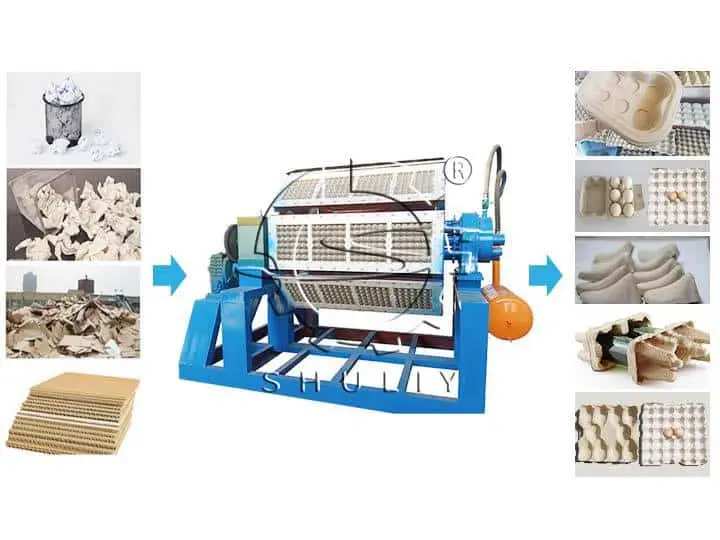
Reciprocating egg tray molding machines, roller egg tray molding machines, and rotary egg tray molding machines are three types of paper egg tray making machines. They differ significantly in advantages, production efficiency, and maintenance costs, and are suited to different production scales. Many customers tend to fall into the trap of blindly pursuing high speed or simply focusing on cost control when selecting equipment. This often leads to a mismatch between the production equipment and actual production needs, increasing operating costs and affecting order fulfillment. Next, we will provide a detailed comparison of these three types of egg tray machines and clarify the production scales and application scenarios best suited to each.
Reciprocating Egg Tray Molding Machine
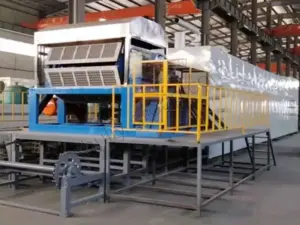
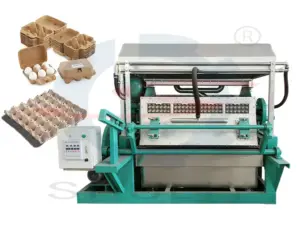
A reciprocating egg tray machine is a type of pulp molding equipment in which the forming mold moves back and forth between the pulp tank and the transfer mold. This intermittent motion pattern enables the processes of egg tray forming and demolding to be completed in a cyclical manner.
Unlike fully automatic rotary systems, reciprocating machines employ a step-by-step workflow; consequently, they feature a simpler structure and offer a more economical cost. Currently, reciprocating egg tray forming machines have become the preferred choice and mainstream equipment for small to medium-sized egg tray production lines.
Motion mode: The upper and lower molds perform vertical reciprocating movement. The lower mold absorbs pulp and then closes with the upper mold to form a wet blank. The upper mold subsequently transfers the wet blank and releases it. The entire process is automated, with no complex transmission structure.
Production capacity: A single machine has a capacity of 1,200–2,500 pieces per hour, with a daily output of 1-5 tons. Total production capacity can be increased by adding more machines, making it flexible for small-batch, multi-specification production.
Equipment specifications: The machine adopts a vertical frame structure with a moderate size, occupying approximately 20–30 square meters. It is easy to install and well-suited for small factory layouts.
Operation & maintenance: The equipment is equipped with a simple PLC control system, with preset parameter templates for multiple egg tray specifications. Production can be initiated with one-click selection. It has few wearing parts, readily available spare components, and low maintenance difficulty, requiring no professional technical personnel.
Core Advantages
High Cost-Effectiveness: Characterized by low investment costs and a short payback period, the initial investment required for this machine is 30%–50% lower than that of rotary or drum-type egg tray molding machines, making it an ideal choice for startups and small-to-medium-sized factories with limited budgets.
High Flexibility: Mold replacement takes less than 20 minutes, allowing for rapid switching between the production of different egg tray specifications—such as 30-cell and 60-cell trays. By simply changing the molds, the equipment can also produce fruit trays, bottle trays, coffee cup carriers, quail egg trays, and various other pulp-molded products, thereby effectively maximizing equipment utilization.
Easy Upgradability: Existing reciprocating molding machines can be upgraded and retrofitted at a low cost without the need to replace the entire unit. Following the upgrade, energy consumption can be reduced by 20%–25%, while the yield rate of finished products can exceed 98%.
Low Maintenance Costs: Featuring a straightforward mechanical structure and a low failure rate, the machine requires minimal technical expertise from operators, and spare parts are readily available. Its long-term operating and maintenance costs are approximately 50% lower than those of the other two types of molding machines.
Applicable Scales and Scenarios
The reciprocating egg tray molding machine is well-suited for small-to-medium-scale investors, newcomers to the egg tray industry, countries with lower labor costs, and enterprises focused on waste paper recycling and eco-friendly packaging. This equipment offers the flexibility to handle small-batch orders involving multiple egg tray specifications, making it particularly suitable for clients in developing regions such as Southeast Asia and Africa. It serves as an ideal solution for production environments with limited factory space or insufficient power supply, as well as for enterprises that prioritize low-cost operations over high-speed, large-scale mass production.
Roller Egg Tray Molding Machine
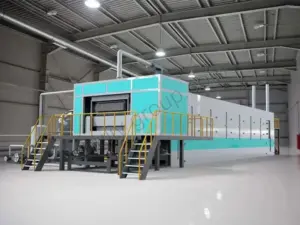
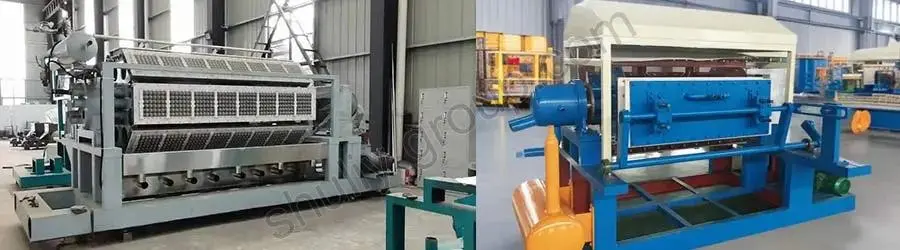
The Roller Egg Tray Molding Machine utilizes a rotating drum (specifically, a drum molding system) to continuously immerse itself in paper pulp, thereby completing the tray-forming process before transferring the molded products to the drying stage. As the egg tray molding equipment with the highest production capacity currently available, it is ideally suited for large-scale manufacturing and capable of efficiently handling high-volume orders. The primary advantages of this equipment lie in its high speed, exceptional efficiency, and energy-saving capabilities, allowing it to perfectly meet the rigorous demands for mass production within large-scale manufacturing facilities. This uninterrupted cyclical process enables continuous production, thereby significantly boosting overall output.
Motion mode: Dual rollers rotate continuously. Molds are mounted on the roller surfaces, and pulp is formed through vacuum suction, enabling continuous production.
Production capacity: A single machine can achieve a capacity of 7,000–12,000 pieces per hour, with a daily output of 10–20 tons. This is 5–8 times that of a reciprocating molding machine, meeting the demand for rapid delivery of large-volume orders.
Equipment specifications: The machine is relatively large in size, occupying approximately 50–80 square meters. Its continuous production line layout can be equipped with a large-scale drying system and automatic stacking devices, offering a high level of automation.
Operation & maintenance: It adopts a fully automated control system and requires professional technical personnel for operation. Key components (rollers and molds) demand high precision, resulting in a moderate level of maintenance complexity. Regular inspection and maintenance of the roller surfaces and vacuum system are required in the later stages.
Key Advantages
High speed & efficiency: Continuous production and a forming speed of 1 second per mold enable output far exceeding that of reciprocating and rotary molding machines, making it ideal for handling large-volume orders of over one million pieces with high delivery efficiency.
Energy saving & consumption reduction: It adopts high-consistency pulping (8%–12%) combined with a waste heat recovery system, reducing unit energy consumption by 25% compared to traditional reciprocating molding machines. Power consumption per ton of product is controlled within 1,800–2,200 kWh, resulting in lower long-term operating costs.
Stable product quality: The double-roller molding machine enables precise temperature control and uniform pulp absorption, ensuring consistent product thickness and high stiffness. The qualified product rate reaches ≥99%, reducing raw material waste. It is suitable for the production of high-end egg trays or large-volume orders.
Scalability advantages: A single machine can meet the mass production needs of large factories without requiring a significant increase in the number of units. This saves factory space and labor costs while improving overall production efficiency.
Applicable Scale and Application Scenarios
The rotary-type egg tray molding machine is ideally suited for large-scale industrial production and is widely utilized in egg tray manufacturing plants, export packaging enterprises, fruit tray production facilities, and the eco-friendly food packaging sector. This equipment is capable of fulfilling large-scale export orders for egg trays destined for regions such as Europe, the United States, and Southeast Asia. It represents the ideal choice for the mass production of standard-specification egg trays, distinguished primarily by its high production capacity, exceptional efficiency, and minimal material wastage. For enterprises possessing ample factory space, a stable power supply, and a robust production management system, this equipment constitutes the optimal choice.
Rotary Egg Tray Molding Machines
A Rotary Egg Tray Molding Machine uses a rotating drum mold system that continuously forms egg trays from pulp. Unlike reciprocating machines, which operate in cycles, rotary machines run non-stop, significantly improving efficiency and output.
Motion mode: A 4/6/8-mold rotary table enables continuous rotation. Each station independently completes pulp suction, forming, and demolding processes, balancing efficiency and flexibility.
Production capacity: A single machine can achieve an output of 3,000–6,000 pieces per hour, with a daily capacity of 5–10 tons. It falls between reciprocating and roller molding machines in terms of productivity, and capacity can be increased by adding more stations.
Equipment specifications: The machine occupies approximately 30–50 square meters. It features a turntable layout and can be equipped with a medium-sized drying system and automatic sorting devices. Its level of automation is higher than that of reciprocating molding machines but lower than that of roller molding machines.
Operation & maintenance: It is equipped with a PLC intelligent control system, offering moderate operational complexity and requiring a small number of skilled technicians. Mold replacement is convenient, and it has fewer wearing parts than roller molding machines. Maintenance costs fall between those of reciprocating and roller molding machines.
Core Advantages
Maximum Efficiency and Exceptional Cost-Effectiveness: Its production capacity is 2 to 3 times that of reciprocating molding machines, with mold changeovers taking less than 30 minutes. The equipment allows for rapid switching between different specifications and types of pulp-molded products, making it ideally suited for production environments characterized by multiple orders and product varieties. Its initial investment cost is 50% lower than that of rotary molding machines, yet its production capacity exceeds that of reciprocating machines. This equipment is particularly suitable for medium-to-large-scale factories seeking to undergo technological upgrades and modernization.
Robust Stability: Supports independent operation across multiple workstations. Should a fault occur at a single station, the remaining stations continue to operate normally, thereby effectively minimizing losses caused by downtime. The equipment boasts an Overall Equipment Efficiency (OEE) of over 88%.
High Product Precision: Each mold is equipped with an independent vacuum system, ensuring uniform and consistent pulp suction. Product thickness deviation is controlled within ±0.2 mm, fully meeting the quality requirements for medium-to-high-end egg tray orders.
Consistent Product Quality: Features uniform thickness, high molding consistency, and a low defect rate.
Applicable Scale and Application Scenarios
The rotary egg tray molding machine is designed for medium-to-large-scale factories—facilities that typically possess a stable source of high-volume orders. This equipment is capable of fulfilling not only medium-to-large-scale orders for egg trays but also supports the production of fruit trays, seedling trays, and various other pulp-molded products. It serves as an ideal choice for factories that require the flexibility to switch between different product specifications, operate within moderate facility spaces, and strive to strike a balance between production efficiency and operational versatility.
Selection Advices
The key to equipment selection is matching your own production capacity, order requirements, and budget. There is no need to blindly pursue high speed, nor to excessively focus on cost reduction.
If you are a startup or a small factory with a limited budget, small-batch orders, and multi-specification production needs, you may prioritize a Reciprocating Egg Tray Molding Machine. It offers a low-cost start and can be upgraded later as needed.
If you are a medium or large factory with stable medium to high-volume orders, and you need to balance efficiency and flexibility while expanding into multiple product categories, you may prioritize a Rotary Egg Tray Molding Machine to achieve a balance between cost and production capacity.
If you are a large-scale factory with stable large export orders and a focus on high-speed mass production, low material loss, and high product quality, you may prioritize a Roller Egg Tray Molding Machine to improve delivery efficiency and market competitiveness.