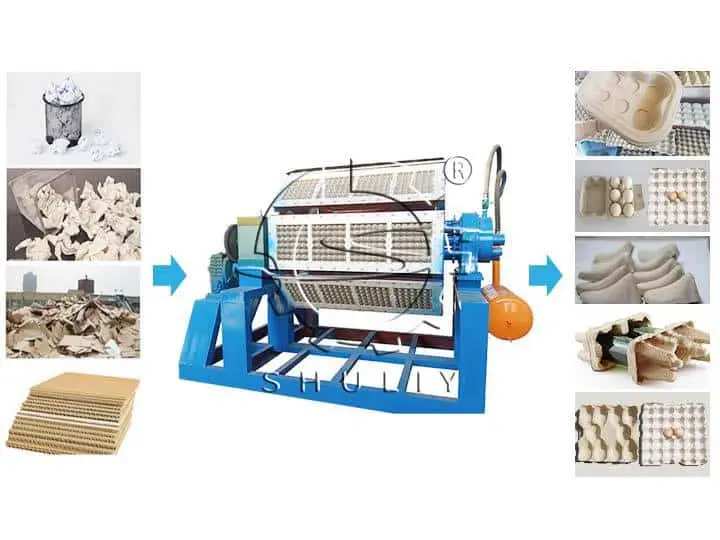
Reciprocating Eierkartonmaschinen, Rollen-Eierkartonmaschinen und rotierende Eierkartonmaschinen sind drei Arten von Papier-Eierkartonherstellern. Sie unterscheiden sich erheblich in Vorteilen, Produktionseffizienz und Wartungskosten und sind für unterschiedliche Produktionsgrößen geeignet. Viele Kunden neigen dazu, blind auf hohe Geschwindigkeit zu setzen oder nur auf Kostensenkung zu achten, was oft zu einer Fehlanpassung zwischen Ausrüstung und tatsächlichem Bedarf führt, die Betriebskosten erhöht und die Auftragsabwicklung beeinträchtigt. Im Folgenden werden wir diese drei Maschinentypen detailliert vergleichen und die am besten geeigneten Produktionsgrößen und Anwendungsszenarien erläutern.
Hin- und hergehende Eierkarton-Formmaschine
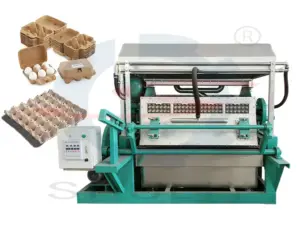
A reciprocating Eierkartonmaschine is a type of pulp molding equipment in which the forming mold moves back and forth between the pulp tank and the transfer mold. This intermittent motion pattern enables the processes of egg tray forming and demolding to be completed in a cyclical manner.
Unlike fully automatic rotary systems, reciprocating machines employ a step-by-step workflow; consequently, they feature a simpler structure and offer a more economical cost. Currently, reciprocating egg tray forming machines have become the preferred choice and mainstream equipment for small to medium-sized egg tray production lines.
Motion mode: The upper and lower molds perform vertical reciprocating movement. The lower mold absorbs pulp and then closes with the upper mold to form a wet blank. The upper mold subsequently transfers the wet blank and releases it. The entire process is automated, with no complex transmission structure.
Production capacity: A single machine has a capacity of 1,200–2,500 pieces per hour, with a daily output of 1-5 tons. Total production capacity can be increased by adding more machines, making it flexible for small-batch, multi-specification production.
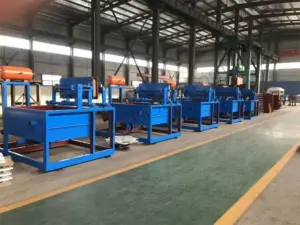
Equipment specifications: The machine adopts a vertical frame structure with a moderate size, occupying approximately 20–30 square meters. It is easy to install and well-suited for small factory layouts.
Operation & maintenance: The equipment is equipped with a simple PLC control system, with preset parameter templates for multiple egg tray specifications. Production can be initiated with one-click selection. It has few wearing parts, readily available spare components, and low maintenance difficulty, requiring no professional technical personnel.
Core Advantages
High Cost-Effectiveness: Characterized by low investment costs and a short payback period, the initial investment required for this machine is 30%–50% lower than that of rotary or drum-type egg tray molding machines, making it an ideal choice for startups and small-to-medium-sized factories with limited budgets.
High Flexibility: Mold replacement takes less than 20 minutes, allowing for rapid switching between the production of different egg tray specifications—such as 30-cell and 60-cell trays. By simply changing the molds, the equipment can also produce fruit trays, bottle trays, coffee cup carriers, quail egg trays, and various other pulp-molded products, thereby effectively maximizing equipment utilization.
Easy Upgradability: Existing reciprocating molding machines can be upgraded and retrofitted at a low cost without the need to replace the entire unit. Following the upgrade, energy consumption can be reduced by 20%–25%, while the yield rate of finished products can exceed 98%.
Low Maintenance Costs: Featuring a straightforward mechanical structure and a low failure rate, the machine requires minimal technical expertise from operators, and spare parts are readily available. Its long-term operating and maintenance costs are approximately 50% lower than those of the other two types of molding machines.
Applicable Scales and Scenarios
Die reciprocating Eierkartonmaschine ist gut geeignet für kleine bis mittelgroße Investoren, Neueinsteiger in die Eierkartonbranche, Länder mit niedrigeren Lohnkosten und Unternehmen, die auf Recycling von Altpapier und umweltfreundliche Verpackungen setzen. Diese Ausrüstung bietet die Flexibilität, kleine Chargen mit mehreren Eierkartonspezifikationen zu verarbeiten, was sie besonders für Kunden in Entwicklungsländern wie Südostasien und Afrika geeignet macht. Sie ist die ideale Lösung für Produktionsumgebungen mit begrenztem Fabrikraum oder unzureichender Stromversorgung sowie für Unternehmen, die niedrige Betriebskosten bei geringem Tempo und großem Volumen anstreben.
Roller Egg Tray Molding Machine
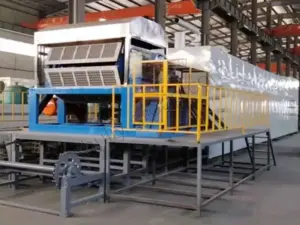
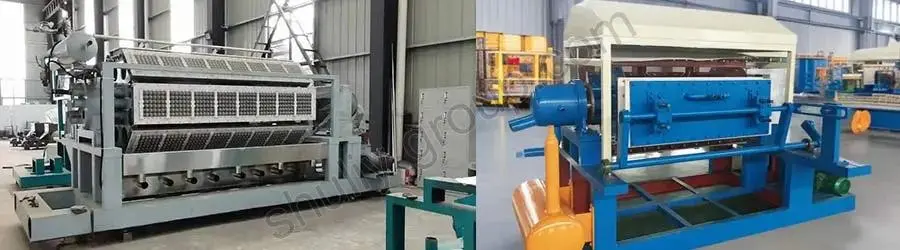
Die Walzen-Eierkarton-Formmaschine nutzt ein rotierendes Trommel- (speziell, ein Trommel-Formensystem), um sich kontinuierlich in Papierpulpe zu tauchen und so den Kartonbildungsprozess abzuschließen, bevor die geformten Produkte in den Trocknungsprozess überführt werden. Als die derzeit leistungsfähigste Eierkarton-Formmaschine mit höchster Produktionskapazität ist sie ideal für die großindustrielle Fertigung geeignet und kann effizient große Auftragsvolumen bewältigen. Die Hauptvorteile dieser Ausrüstung liegen in ihrer hohen Geschwindigkeit, außergewöhnlichen Effizienz und energiesparenden Fähigkeiten, wodurch sie die strengen Anforderungen an die Massenproduktion in groß angelegten Fertigungsanlagen perfekt erfüllt. Dieser ununterbrochene zyklische Prozess ermöglicht eine kontinuierliche Produktion und steigert somit die Gesamtleistung erheblich.
Motion mode: Dual rollers rotate continuously. Molds are mounted on the roller surfaces, and pulp is formed through vacuum suction, enabling continuous production.
Production capacity: A single machine can achieve a capacity of 7,000–12,000 pieces per hour, with a daily output of 10–20 tons. This is 5–8 times that of a reciprocating molding machine, meeting the demand for rapid delivery of large-volume orders.
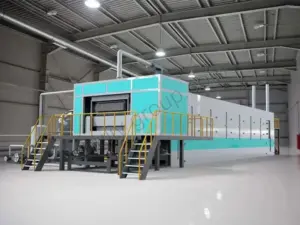
Equipment specifications: The machine is relatively large in size, occupying approximately 50–80 square meters. Its continuous production line layout can be equipped with a large-scale drying system and automatic stacking devices, offering a high level of automation.
Operation & maintenance: It adopts a fully automated control system and requires professional technical personnel for operation. Key components (rollers and molds) demand high precision, resulting in a moderate level of maintenance complexity. Regular inspection and maintenance of the roller surfaces and vacuum system are required in the later stages.
Wichtige Vorteile
High speed & efficiency: Continuous production and a forming speed of 1 second per mold enable output far exceeding that of reciprocating and rotary molding machines, making it ideal for handling large-volume orders of over one million pieces with high delivery efficiency.
Energy saving & consumption reduction: It adopts high-consistency pulping (8%–12%) combined with a waste heat recovery system, reducing unit energy consumption by 25% compared to traditional reciprocating molding machines. Power consumption per ton of product is controlled within 1,800–2,200 kWh, resulting in lower long-term operating costs.
Stable product quality: The double-roller molding machine enables precise temperature control and uniform pulp absorption, ensuring consistent product thickness and high stiffness. The qualified product rate reaches ≥99%, reducing raw material waste. It is suitable for the production of high-end egg trays or large-volume orders.
Scalability advantages: A single machine can meet the mass production needs of large factories without requiring a significant increase in the number of units. This saves factory space and labor costs while improving overall production efficiency.
Applicable Scale and Application Scenarios
Die rotierende Eierkartonmaschine eignet sich ideal für die großindustrielle Produktion und wird häufig in Eierkartonfabriken, Exportverpackungsunternehmen, Obstkistenfabriken und im umweltfreundlichen Lebensmittelverpackungssektor eingesetzt. Diese Ausrüstung ist in der Lage, große Exportaufträge für Eierkartons für Regionen wie Europa, die USA und Südostasien zu erfüllen. Sie ist die ideale Wahl für die Massenproduktion von Standard-Eierkartons, vor allem aufgrund ihrer hohen Produktionskapazität, außergewöhnlichen Effizienz und minimalen Materialverschwendung. Für Unternehmen mit ausreichend Fabrikraum, stabiler Stromversorgung und einem robusten Produktionsmanagementsystem stellt diese Ausrüstung die optimale Wahl dar.
Rotary Egg Tray Molding Machines
Eine Dreh-Eierkarton-Formmaschine verwendet ein rotierendes Trommel-Formensystem, das kontinuierlich Eierkartons aus Pulpe formt. Im Gegensatz zu hin- und hergehenden Maschinen, die in Zyklen arbeiten, laufen Drehmaschinen ununterbrochen, was die Effizienz und den Output erheblich verbessert.
Motion mode: A 4/6/8-mold rotary table enables continuous rotation. Each station independently completes pulp suction, forming, and demolding processes, balancing efficiency and flexibility.
Production capacity: A single machine can achieve an output of 3,000–6,000 pieces per hour, with a daily capacity of 5–10 tons. It falls between reciprocating and roller molding machines in terms of productivity, and capacity can be increased by adding more stations.
Equipment specifications: The machine occupies approximately 30–50 square meters. It features a turntable layout and can be equipped with a medium-sized drying system and automatic sorting devices. Its level of automation is higher than that of reciprocating molding machines but lower than that of roller molding machines.
Operation & maintenance: It is equipped with a PLC intelligent control system, offering moderate operational complexity and requiring a small number of skilled technicians. Mold replacement is convenient, and it has fewer wearing parts than roller molding machines. Maintenance costs fall between those of reciprocating and roller molding machines.
Core Advantages
Maximum Efficiency and Exceptional Cost-Effectiveness: Its production capacity is 2 to 3 times that of reciprocating molding machines, with mold changeovers taking less than 30 minutes. The equipment allows for rapid switching between different specifications and types of pulp-molded products, making it ideally suited for production environments characterized by multiple orders and product varieties. Its initial investment cost is 50% lower than that of rotary molding machines, yet its production capacity exceeds that of reciprocating machines. This equipment is particularly suitable for medium-to-large-scale factories seeking to undergo technological upgrades and modernization.
Robust Stability: Supports independent operation across multiple workstations. Should a fault occur at a single station, the remaining stations continue to operate normally, thereby effectively minimizing losses caused by downtime. The equipment boasts an Overall Equipment Efficiency (OEE) of over 88%.
High Product Precision: Each mold is equipped with an independent vacuum system, ensuring uniform and consistent pulp suction. Product thickness deviation is controlled within ±0.2 mm, fully meeting the quality requirements for medium-to-high-end egg tray orders.
Consistent Product Quality: Features uniform thickness, high molding consistency, and a low defect rate.
Applicable Scale and Application Scenarios
Die rotierende Eierkartonmaschine ist für mittelgroße bis große Fabriken konzipiert – Anlagen, die typischerweise eine stabile Quelle für Großaufträge besitzen. Diese Ausrüstung kann nicht nur mittelgroße bis große Aufträge für Eierkartons erfüllen, sondern unterstützt auch die Produktion von Fruchtkisten, Setzlingskisten und anderen pulpgeformten Produkten. Sie ist die ideale Wahl für Fabriken, die die Flexibilität benötigen, zwischen verschiedenen Produktspezifikationen zu wechseln, innerhalb moderater Anlagenräume arbeiten und eine Balance zwischen Produktionseffizienz und Betriebsvielseitigkeit anstreben.
Selection Advices
Der Schlüssel zur Auswahl der Ausrüstung liegt darin, die eigene Produktionskapazität, Auftragsanforderungen und Budget abzustimmen. Es ist nicht notwendig, blind auf hohe Geschwindigkeit zu setzen oder sich ausschließlich auf Kostensenkung zu konzentrieren.
Wenn Sie ein Start-up oder eine kleine Fabrik mit begrenztem Budget, Kleinserienaufträgen und Mehrfachspezifikationsproduktionsbedarf sind, könnten Sie eine hin- und hergehende Eierkarton-Formmaschine priorisieren. Sie bietet einen kostengünstigen Einstieg und kann bei Bedarf später aufgerüstet werden.
Wenn Sie eine mittelgroße oder große Fabrik mit stabilen mittel- bis hochvolumigen Aufträgen sind und Effizienz sowie Flexibilität ausbalancieren möchten, während Sie in mehrere Produktkategorien expandieren, könnten Sie eine Dreh-Eierkarton-Formmaschine priorisieren, um ein Gleichgewicht zwischen Kosten und Produktionskapazität zu erreichen.
Wenn Sie eine groß angelegte Fabrik mit stabilen großen Exportaufträgen sind und sich auf Hochgeschwindigkeits-Massenproduktion, geringe Materialverluste und hohe Produktqualität konzentrieren, könnten Sie eine Walzen-Eierkarton-Formmaschine priorisieren, um die Liefereffizienz und die Wettbewerbsfähigkeit auf dem Markt zu verbessern.